Tuesday, April 30, 2024

Basic Elements of Design: Design Principles and Software Overview

basic design

They're even present in seemingly unimportant details, like the fonts that make up most compositions. Some online graphic makers can also help you do the job faster. With Renderforest Graphic Maker you can browse through the professional templates created by our team of designers, choose the ones you need, and start editing them. To have unity in your design, all parts of your composition should be in complete harmony with each other to be visually appealing in the viewer’s eyes.

Basic Elements of Design: Design Principles and Software Overview

How Do You Design a Robot? - Design News

How Do You Design a Robot?.

Posted: Wed, 06 Mar 2024 08:00:00 GMT [source]

In our daily lives, we tend to forget that shapes surround us. Their effect on our psyche is partly due to our evolutionary upbringing — some shapes instill comfort, others make us cautious. Shapes are important because they're the foundation of so many things. Learn to look for them in other designs, and soon you'll start seeing them everywhere.

Learn More about Design Principles

The Essential Guide to Bauhaus Design - House Beautiful

The Essential Guide to Bauhaus Design.

Posted: Sat, 10 Feb 2024 08:00:00 GMT [source]

For example, if you’re designing any kind of logo, you can create contrast with a pink background, blue or green elements, and white text. Create variety by adding unique or unexpected elements to your designs. Variety can be used to draw the user’s attention to specific elements or areas of the design, and make them stand out. Proportion, also referred to as scale, is the relative size of objects within a design. Elements that are larger in relation to others will stand out more and appear to have more importance to users. Inexperienced designers may inadvertently emphasize the wrong parts of the page, creating confusion on the part of the user.

Negative Space

Emphasis in design principles refers to intentionally highlighting specific elements to draw attention and create a focal point. By manipulating contrast, color, size, or placement, designers can guide the viewer's eye to the most crucial parts of a composition. Emphasis ensures that certain design elements have more visual weight, allowing them to stand out and capture interest. This principle helps convey the main message, evoke emotions, or guide user behavior. All design elements and principles—typography, colors, images, shapes, patterns, etc.—carry a visual weight.

What are the elements of visual design?

This can refer to their alignment in relation to the entire composition (left, center, or right-aligned) as well as their alignment to one another. Whichever type of balance technique you use, the result should feel right. It should give the viewer a sense of harmony and not make them feel uneasy. In select learning programs, you can apply for financial aid or a scholarship if you can’t afford the enrollment fee. If fin aid or scholarship is available for your learning program selection, you’ll find a link to apply on the description page.

Unity
basic design

When it comes to spoken language, we typically use a variety of factors to convey how we feel — rhythm, pitch, tone, gestures, and so forth. Typography also has a diverse set of characteristics that modulate the feelings that a text can evoke  — size, weight, kerning, position, and so forth. We find this type of composition appealing because, according to studies, the human eye naturally follows this path when scanning a design. For beginners, textures make great background images and can add a lot of interest to your work. Look closely, and you may find texture in unexpected places, like distressed fonts and smooth, glossy icons.

The associative mind of a customer can link your emailer with the massive signage they saw on your office building and put two-and-two together. To ensure that your design has a coherent flow, it’s essential to look into a couple of traditional layouts. Our brains are hardwired to observe things that are out of place. These visual or structural outliers pique our interest and draw our attention. Conceptual unity is all about combining information for the user’s comfort and ensuring that they have to perform as little interactions while going from point A to point B. Fundamentally, your choice should be guided by the message, the medium, and the audience you’re writing for.

All open-source articles on design principles

The words “Interaction Design Foundation” form an implied semicircular line in our logo. Be consistent with navigational mechanisms, organizational structure, etc., to make a stable, reliable and predictable design. Focus on emotion – the pleasure of use is as vital as ease of use; arouse users’ passion for increasing engagement.

What is the strongest element of design?

A designer is a visual storyteller, a person who pairs words with images and typography to best convey information to an audience. Good design evokes emotion and presents the news of the day with clarity and the proper tone. A business card, brochure, or website that has good design provides content that is more inviting, more easily comprehensible and is faster to process. Design isn’t about “making it look pretty,” it’s also about content, layout and audience analysis.

Saves your settings and preferences, like your location, for a more personalized experience. Throughout the course, we’ll supply you with lots of templates and step-by-step guides so you can go right out and use what you learn in your everyday practice. Dominance can be established by using positioning, shape and colour, among many other factors. Red, a colour with high contrast, is used widely in iOS for the “Delete” function. Around 2011, Apple introduced a widespread use of linen texture (which first appeared on iOS) in all of its operating systems.

Color sets the tone for the piece and conveys information about the company through symbolism. Rhythm lets you pick a style where you can consistently deliver valuable information to customers with a smaller learning arch. It creates a sense of movement for the viewer by repeating patterns, phrases, and shapes. Good design isn’t about many years of practice and thousands of hours spent in graphic editor tools.

Even images that are less realistic use similar techniques to create dimension. Below, the lighting and shading are stylized, but still hint at form and depth. They can also be implied through illustration, using techniques like light, shadow, and perspective to create the illusion of depth. The fundamentals can be intimidating at first, especially if you don't consider yourself an artist. But keep an open mind—there's a lot they can teach you about working with different assets and creating simple visuals from scratch.

Thirdly, a lack of white space can take its toll on the eyes and brain. Let’s go back to Arngren and Apple for a second — imagine you’re looking for something on the first site; a microwave oven, for instance. Furthermore, pay attention to how tiring this experience is to the eye. Lines are the most seamless and most powerful elements of design.

The 12 Principles Of Design Explained: Complete Guide + Uses

basic design

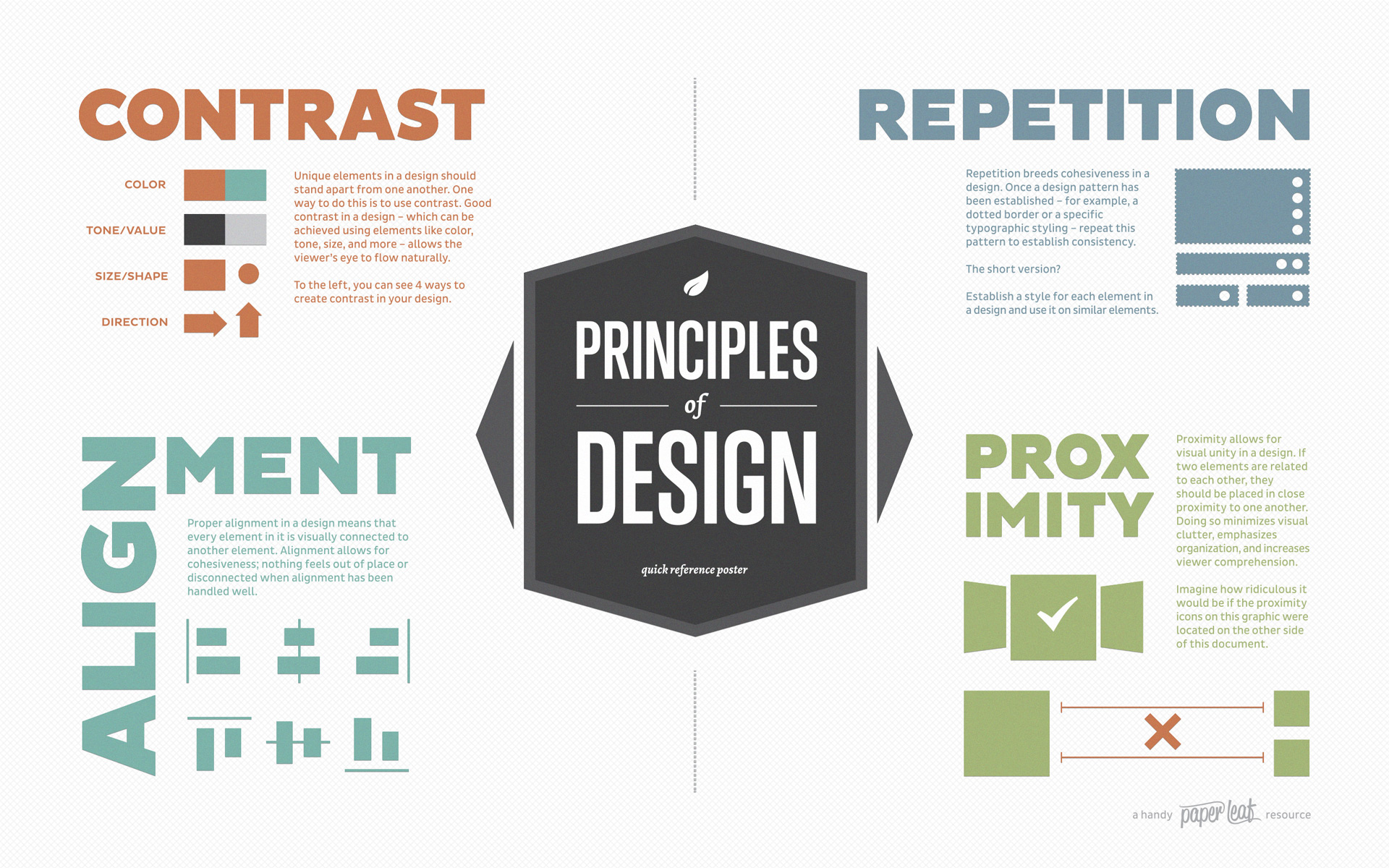
These days, using patterns and repetition of the same elements is trendy both for print and fashion. To have a perfect emphasis on your design you need to have a clear understanding of what’s important in your composition. Otherwise, your design will be unbalanced and messy, and as a result, it won’t be able to fulfill its purpose. Employ repetition in simple ways—such as using the same icons throughout, in background patterns, or through things like styling all of your photos in the same way. When elements aren’t aligned properly, especially in relation to one another, it adds a sense of chaos to the composition. Alignment refers to how text or graphic elements are lined up on a page.

Ready to make your logo?

It’s interesting how such a simple element can yield such a strong effect on our attention and have such a complex meaning in the modern visual grammar. An essential first step on the journey towards good design is understanding what it is at its core. We often mistakenly believe that it has a decorative function — it’s meant to make things pretty and appealing. This insight can be applied to almost any type of project, whether you're creating your own graphics or just looking for simple ways to enhance your work.

What is the strongest element of design?

Achieving balance creates a sense of harmony, stability, and equilibrium. White space isn’t necessarily white; it can be of any color, texture, and so forth. Simply put, it’s the area that surrounds one or more elements of your design.

Beginning Graphic Design -

One of the most common complaints designers have about client feedback often revolves around clients who say a design needs to “pop” more. While that sounds like a completely arbitrary term, what the client generally means is that the design needs more contrast. You can also learn with your fellow course-takers and use the discussion forums to get feedback and inspire other people who are learning alongside you.

basic design

It can also be achieved when the vertical axis that divides two elements isn’t placed directly in the center of the page. In that case, the narrower element should have a “heavier” visual weight than the wider one to achieve a balanced look. There’s much debate over exactly how many principles of design exist. Some designers say 7, others 12, and still others somewhere in between. But when it comes to design principles, numbers aren’t the important thing.

Balance is the equal distribution of visual weight (more specifically, how much any one element attracts the viewer's eye). Balance can be affected by many things, including color, size, number, and negative space. Use proportion to create visual interest by drawing the viewer’s eye to particular visual elements within your designs.

We can imagine a centre point of the design and distribute the elements in a way that creates balance. For instance, consistency ensures that controls remain uniform throughout a design, while proximity suggests related items be grouped. Visual hierarchy places importance on presenting the most vital information at the top. By understanding and applying these principles, designers can create intuitive, aesthetically pleasing, and practical designs that cater to user needs and preferences.

Wallpaper patterns are the most ubiquitous example of patterns that virtually everyone is familiar with. This article, for example, uses repetition in the format of the headings. Each design principle is formatted the same as the others in this section, signaling to readers that they’re all of equal importance and that they’re all related.

Beginning Graphic Design: Fundamentals of Design

Now that you know the basic principles of design, it’s time to put them into practice. The recurrence of an element, color, shape, or form in design is called repetition. It unifies your design elements and gives them a kind of signature look.

Disregarding these principles of design should be done with caution, and only after you have a thorough understanding of them and the purposes they serve. If everything on your page looks like it has the same importance, then nothing appears important. You need to use visual cues to tell people what to pay attention to first, second, third, etc.

Like every story, a design should have a beginning and an end. The way a viewer’s eye travels over the design, the way they “read” it, is told by movement. When you enroll in the course, you get access to all of the courses in the Specialization, and you earn a certificate when you complete the work.

If there is no relationship between your two or more elements, your design will give a messy and unprofessional feel. So, to achieve unity, you should organize all your visual elements and make them work together in a single design composition. By repeating elements, you create a pattern and strengthen your design. Your ship should be balanced to move forward with ease, and the same goes for the visual elements of your design.

We use them to separate and organize space, outline and contour objects, emphasize certain elements, draw attention, and so forth. Before we dive into the central principles of design, let’s explore its basic elements. Asymmetrical designs are different, but the weight is still evenly distributed. The composition is balanced because it calls attention to the right things (in this example, the person's name and company logo).

More importantly, it’s a good idea to think of them as parts of a large system. Making a design too unified, might cause it to seem dull and unappealing. White space has become especially relevant in the last 15 years, as designers started moving away from extremely crammed and disorienting interfaces. Our brains are hardwired to seek patterns and similarities in our surroundings. In design, we can also use alteration and gradation to trigger pattern-like thinking. Given that designs are created by people, we can immediately conclude that an existing contrast is there for a reason.

Shibarium Basic Design Explained by SHIB Team Member: Details - U.Today

Shibarium Basic Design Explained by SHIB Team Member: Details.

Posted: Sun, 27 Aug 2023 07:00:00 GMT [source]

Take the hidden arrow in the FedEx logo, for just one example. As already mentioned, there is no real consensus in the design community about what the main principles of design actually are. That said, the following twelve principles of visual design are those mentioned most often in articles and books on the subject. Search for “principles of design” and Google will return results for articles that include from five to more than a dozen individual visual design principles. Even the articles that agree on the number don’t necessarily agree on which ones should be included in that number. Some designs make use of negative space to create interesting visual effects.

Color is not traditionally classified as a principle of design in art. However, color is essential in creating visual interest and evoking emotions in design. When it comes to design, color is one of the first things that both users and designers notice. It can function as a standalone element or serve as a backdrop for others, such as lines, forms, textures, or typography.

Our Best Cash Back Business Credit Card Signify Business Cash

Table Of Content What benefits are included in the Signify Business Cashservice mark℠ Card? Which banks let you personalize your credit card...